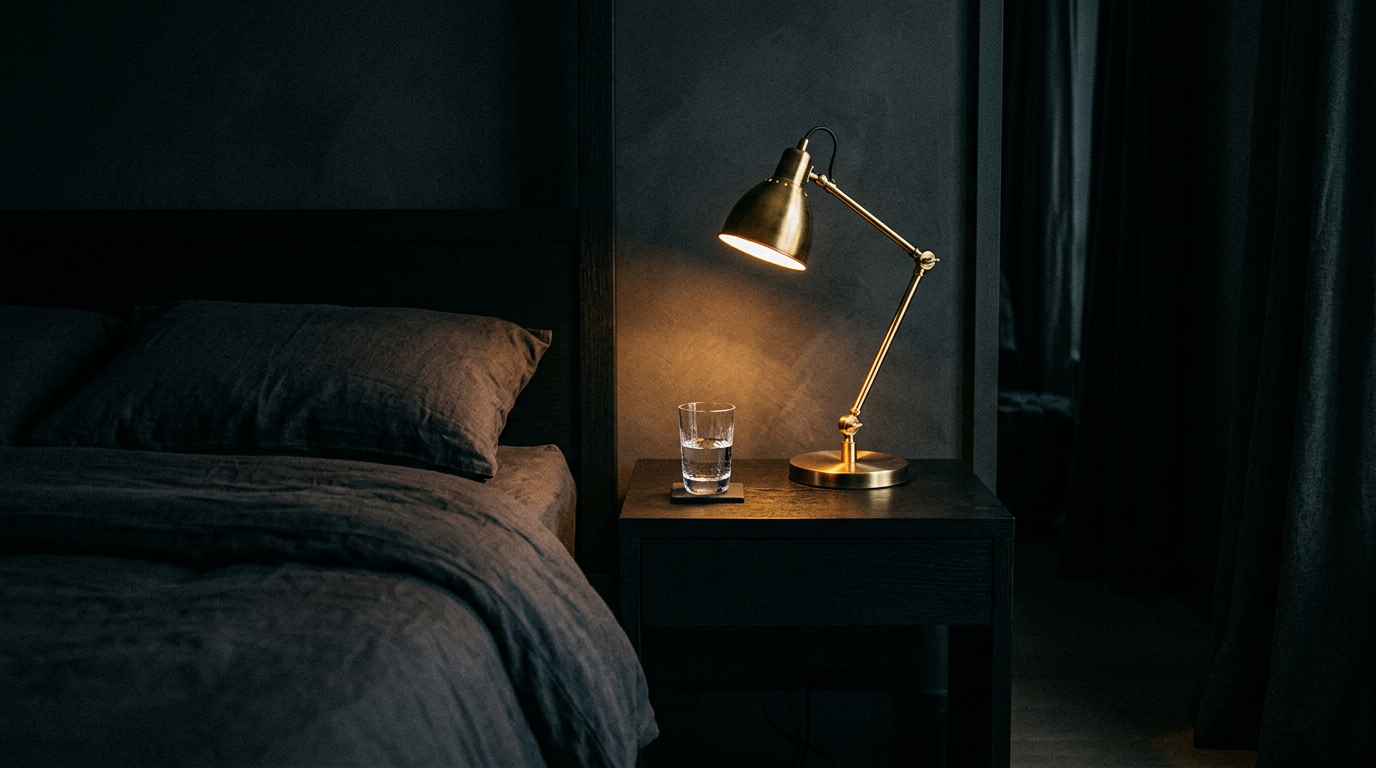
It is the difference between a room that was designed and a room that was assembled. Between a builder who asked how you actually use a bedroom and one who copied dimensions from a previous project. Between a home that makes your life slightly better every single day and one that makes your life slightly worse — at 3am, specifically, when everything reveals itself.
I've spent a lot of nights in rooms where someone got this right. The right distance. The right lamp height so the light falls on a book and not your eyes. The right glass — wide enough to find in the dark without looking. The right temperature in the room when you arrive, already cooled. These details don't announce themselves. That's precisely the point. You only notice them when they're wrong.
WHAT I WAS ACTUALLY LOOKING FOR
When I check into a room, I'm not looking at the view. I'm running a quiet diagnostic. I open the blackout curtains and check for light bleed at the bottom edge — because light bleed at 6am is a sabotage. I sit on the edge of the bed and check the table distance with my arm, eyes closed. I find the toilet in the dark without turning on a light — the path should be clear, the handle exactly where you'd expect. I check the tap direction without reading the label.
"A room reveals itself at 3am. That's when every decision the designer made becomes either invisible — or a small act of violence against your sleep."
The rooms that pass this diagnostic all have something in common: someone on the design team asked "what does a person actually do in here?" — and answered it with specificity. Not with a mood board. With measurements. With the observation that a glass of water needs to be within arm's reach. That the reading light should be adjustable. That the path to the bathroom should have no corners to stub a toe on.
Most rooms fail. Even expensive ones. Especially expensive ones — because expensive often means the budget went on the marble in the lobby rather than the thinking in the bedroom.
THE SPECIFIC THINGS THAT MATTER
- Bedside table height: level with the top of the mattress, or within 5cm above it. Never lower.
- Table distance from the bed edge: 30–40cm. Reachable lying flat without sitting up.
- Blackout system: no light bleed. Not from the bottom of the curtain. Not from the curtain rail gap. Not from the door. Zero.
- Reading light position: above and slightly behind the head. Adjustable. Falls on paper, not on eyes.
- Room temperature on arrival: pre-set. Walking into a warm room that takes 20 minutes to cool down is a failure of thought, not temperature.
- Toilet path in the dark: clear of furniture legs, turned corners, and misplaced luggage racks. Memorisable in one walk-through.
- Mattress firmness: the kind that supports without feeling like a board. This requires testing — not ordering from a spec sheet.
WHAT I'M BRINGING BACK
I want to be clear about what I'm not doing. I'm not trying to make a Hyderabad home feel like a hotel. Hotels are transient spaces designed around a universal guest. A home is permanent. It should be designed around a specific life.
What I'm borrowing is the discipline — the practice of asking precise questions about how a space actually gets used, then answering them with precise decisions. The bedside table isn't at that distance because it looks good in a floor plan. It's at that distance because that's where it needs to be for a sleeping human to reach it without waking up.
Every room in a Garbage home goes through this diagnostic before it's finalised. Not once. Every iteration. Because the first answer is usually the lazy one. The right answer comes after you've slept in the room in your head enough times to know exactly what will fail you at 3am.
The bedside table will be at the right distance. You won't notice it. That's how you'll know it's right.